Isis the winged goddess the eye of Ra
Isis was originally an unknown goddess with no temple but her importance to the Egyptians grew and grew.Until she became one of the most important gods of ancient Egypt. Isis was the sister and wife of the god Osiris. Isis was important when the story of Isis began when Seth dismembered Isis's body and scattered her body parts throughout Egypt. Seth plotted to kill her brother or husband. Seth imprisoned Osiris in a decorated wooden chest which he covered with lead and threw into the Nile River. The chest became Osiris's sarcophagus.

Isis began as a link to her husband Osiris. After being worshipped for thousands of years there is no mention of Isis before the Fifth Dynasty around 2465–2325 BC. Ancient sacred stories say that the other gods were so impressed by Isis's devotion to finding her husband in the afterlife of Osiris the ruler of the underworld that they helped her successfully resurrect him. Isis is mentioned several times in the Pyramid Texts around 2350–2100 BC. The help of the dead king in the afterlife The concept of the afterlife became something that Isis could help the dead Egyptians. Isis was very important because she had the power of different gods. Beginning as both a leader of magic a protector of women Isis healed the sick and raised the dead as a role model for all women. The myths about Isis are the daughter of the earth god Geb and the sky goddess Nut and sister of the gods.

The interior walls of the Temple of Seti I in Abydos Egypt show evidence of ritual offerings to the gods Osiris and Isis or Hathor
Isis began as a link to her husband Osiris. After being worshipped for thousands of years there is no mention of Isis before the Fifth Dynasty around 2465–2325 BC. Ancient sacred stories say that the other gods were so impressed by Isis's devotion to finding her husband in the afterlife of Osiris the ruler of the underworld that they helped her successfully resurrect him. Isis is mentioned several times in the Pyramid Texts around 2350–2100 BC. The help of the dead king in the afterlife The concept of the afterlife became something that Isis could help the dead Egyptians. Isis was very important because she had the power of different gods. Beginning as both a leader of magic a protector of women Isis healed the sick and raised the dead as a role model for all women. The myths about Isis are the daughter of the earth god Geb and the sky goddess Nut and sister of the gods.
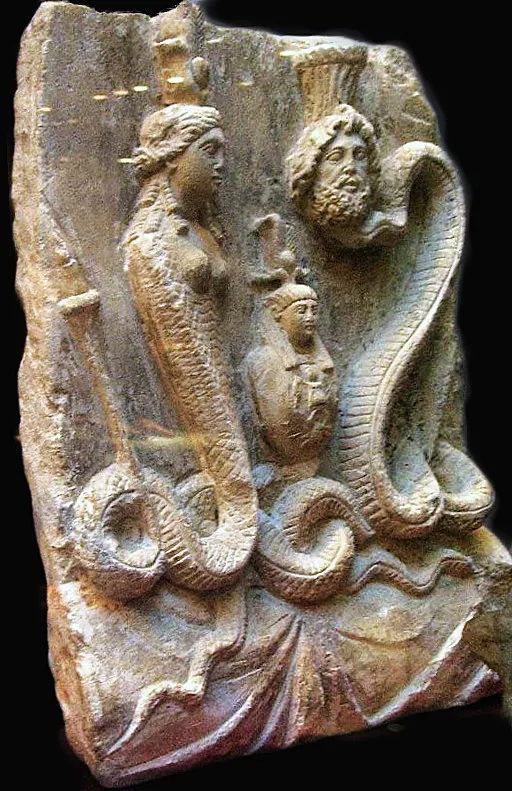
Isis and Osiris in the form of Serapis have the body of a serpent Mecanopus between them. between them the little Horus / Harpokrates
The Queen of the Universe In Roman times the Greek word for throne in ancient Egyptian the most important goddess in Roman times was Isis who controlled the power of fate. The ancient Egyptians called her Isis or Azet the Queen of the Throne. This can be seen from the headdress of Isis. She wears the vulture headdress of the goddess Mut which is believed to have belonged to the goddess Hathor. The power of the goddess Isis is that she is a winged goddess who brings fresh air to the underworld when she meets Osiris. Isis is also the mother of Horus who protects the pharaohs.

Isis is the main goddess in rituals involving the dead. As a healer by magic the cult of Isis continued to be revered by the pagans and spread throughout the Roman Empire worshipped from Britain to Afghanistan. As a close mourner of the Egyptian royal family Isis was often depicted as a beautiful woman in tight dresses wearing hieroglyphics a throne or solar disk and a head with the horns of a bull. She sometimes appeared as a scorpion a bird a pig a queen who helped her husband and taught Egyptian women how to weave bake and brew beer. Isis power could save those bitten by poisonous snakes. Just as Isis helped Horus with a protective spell against Isis's snake bite.
Goddess of Resurrection

A bas-relief depicting the goddess Isis with her wings outstretched in protective gesture appears at the foot of the outermost golden sarcophagus of Pharaoh Tutankhamun from the New Kingdom of ancient Egypt.
Isis was often invoked to help the sick and along with Nephthys and Sehmet to protect the dead. She is associated with many other goddesses and is known as the goddess of the Egyptian gods.The first major temple dedicated to Isis was built by King Nectanebo II and other important temples include the one on the island of Philae. Created during the Greco-Roman era when the goddess Isis wielded more power than the Egyptian goddesses numerous temples were dedicated to her in Alexandria. Isis was the patron goddess of sailors and merchants. From Alexandria the cult of Isis spread to Greece and Rome. The image of Isis breastfeeding Horus may have influenced the depictions of the Virgin Mary and Jesus in childhood by early Christian artists.


